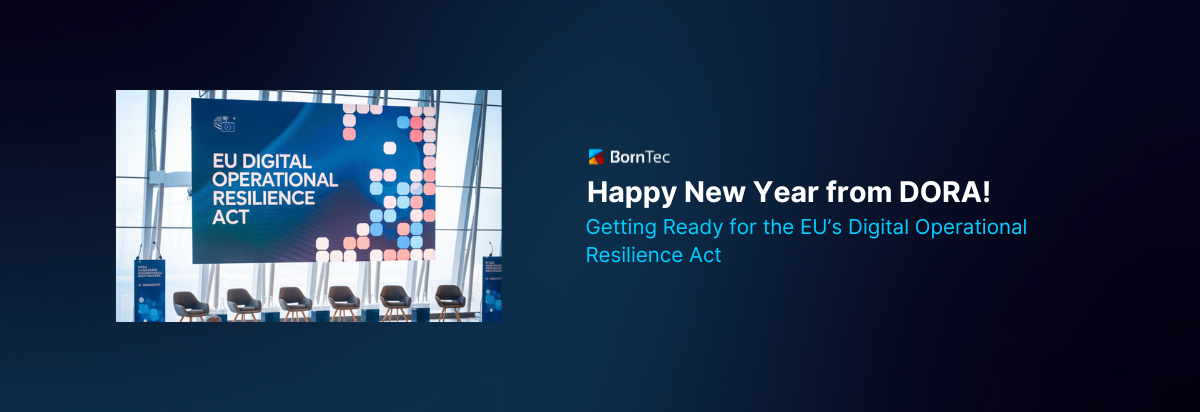
Happy New Year from DORA! Getting Ready for the EU’s Digital Operational Resilience Act

Turning the calendar page to December naturally leads to reflection about the year that has just passed as well as a gaze forward to see what looms in the future. In the present case, 2024 was a year many referred to as organized chaos that was characterized by plenty of growth but also plenty of disruption. Now, whilst we prepare for 2025 and set our tasks and goals for the year with the hopes of conditions that are more “normal” alas, we have to deal with DORA.

The EU’s Digital Operational Resilience Act (DORA) comes into effect in January 2025. DORA differs from MIFiD II because it’s short on explicit rules and long on suggested guidelines. Many of the customers and prospects that we talk to complain that they wish that regulators would “Tell me what you want me to do, and I will do it” while others boldly proclaim “This is nothing we are not already doing!” Both of these responses miss the mark because DORA is designed to be self-reflective. So, whilst there will be a good measure of “hurry up and wait” to DORA, it is a good time to think about running yourself through the ringer. 

What Is DORA?

DORA is meant to address a perceived gap in EU financial regulation: how to address operational resilience in a 21st century enterprise. While it was possible in the past to construct a “high wall / wide moat” defense, that no longer works given the interconnected relationships with cloud providers and other third parties that modern businesses rely upon.

Instead of dealing with operational risks by simply allocating capital to cover potential losses, DORA goes deeper and wider to both help prevent disruptions in information and communications technology (ICT) and to have plans in place to handle them when they occur. Put another way, DORA goes beyond protection to mandate measures for detection, containment, recovery and repair as well. 

The five pillars of DORA are ICT Risk Management, Incident Reporting, Operational Resilience Testing, Third-Party Risk Management, and Information Sharing. Broadly, this means creating and maintaining a thorough risk management plan that includes procedures for incident reporting, regular testing programs, analysis of dependencies with third parties and plans to address any disruptions with them, and, perhaps most importantly, policies and procedures to share information on both the successes and challenges 

Getting to the Heart of DORA

Unlike past mandates like Dodd Frank and MIFiD II, DORA is less about specific rules and more about principles and objectives. This may change over time as DORA matures, but for now it’s important to realize that the key to compliance is to do the work of self reflection and analysis that meets both the letter and the spirit of the regulation. At this point, lawyers and consultants seem to be reaping the greatest amount of work (and profit) from DORA but that too will change over time.

At its heart, DORA is about reflection and analysis. Taking that perspective, it’s possible to make DORA work for your business now. In addition to meeting requirements, DORA is a good motivator and tool to examine current operations and identify gaps that require attention. In the long run, it will lead to better performance so why not get started sooner rather than later? Instead of treating DORA as an annoying cost of doing business, welcome it as an opportunity to get a step ahead of the competition.

DORA is About Data

All of the above is important but the core insight about DORA is that effective compliance will be entirely dependent on data. Are you confident that you will have access to all your trading data in real-time following an outage from all of your third-party providers? What about the data schema you require? Can you drive the trade processing “machines” without pulling in small armies of talented support staff to do so – if they’re even available!? Is it possible to extract disparate and siloed data sets from across your trading/middle office tech stack and then re-shape and normalize it for easy use?. All of these questions need to be addressed and steps need to be taken to address any gaps that appear.

In order to meet business needs for DORA and beyond, data is the key. Not only is access to your trading data fundamental to business continuity during unforeseen downtime, it also lays the foundation to improve operational efficiency from top to bottom. Not many can say “Yes” with confidence once they examine the issue because there are always outliers. However, trading Data is 100% interoperable if you lay the right technology foundations and this is a core competency for BornTec CrossCheck. Contact us to learn more about how we can support your efforts at operational resilience.

Video: BornTec CEO Derek Haworth Emphasizes Data Integrity and Operational Resilience at FIA Boca 2024

Andy Jennings is EMEA Director of BornTec, a technology solutions firm that provides data management and tools to support operational resilience and surveillance, risk, compliance, and regulatory reporting functions in financial markets. Contact us to learn more.

More

Pillars, Challenges, and Mentions: Recap of the FIA’s Washington Outlook Event

When it comes to trade associations, few fields are as well served as the futures industry is with the Futures Industry Association (FIA). Outcomes-focused, professional, and relentlessly innovative, the FIA doesn’t kowtow to the biggest exchanges or banks (generally, anyways) and maintains a strong international presence that is backed by their consistent integrity. These qualities were on display as they hosted a Washington Outlook panel in Chicago. 

Led by FIA President Walt Lukken and featuring Jimmy Ryan of Avoq and Kyle Glenn, head of Government Relations for the FIA, the conversation focused in large part on the upcoming U.S. elections, but the most valuable portion of the event, besides the opportunity to network with our industry peers, was Lukken’s opening remarks.

Lead with the Chicago Fire

Lukken began his remarks by noting that it was 173 years ago that the Great Chicago Fire occurred, killing approximately 300 people and wiping out nearly all of Chicago’s downtown. Legend had it that the fire was begun by a cow owned by Mrs. O’Leary, a myth long since debunked, and Lukken compared the blame placed erroneously on the cow and Mrs. O’Leary to the way that the futures industry has often been incorrectly labeled as the source of market disruptions like the 1987 crash or 2008 financial meltdown. Both the cow and the futures industry have been victims of a bad rap.

From there, Lukken broke his remarks down into three areas: pillars, challenges, and mentions.

Within pillars, Lukken touched on growth, competition and modernization. 

  • This is the 7th year running that the industry has experienced record growth, and while an explosion of retail business in India and elsewhere accounts for part of that, the broad based growth can be marked down to the benefits of standardization, accessibility, and ability to hedge risk. 
  • Competition is also strong, sometimes in long established product areas like interest rates with the launch of FMX or energy markets, but also with the renewed interest in establishing new FCMs.
  • Modernization is displayed in a collective effort to address long-standing inadequacies in the middle and back office, with both standards setting efforts by DMIST and tokenization being examples of how technology is driving positive change.

As for challenges, the three areas mentioned were cost, geopolitics, and disruptive technology.

  • In short, the cost of clearing is expensive and it’s getting even more so. Not only is it expensive to scale but capital costs may be rising as well. (More on that later.)
  • It should go without saying that elections as well as conflicts in both Ukraine and the Middle East that could explode into bigger wars are potentially destabilizing. While the futures industry is well built to withstand shocks, the effect of large shocks is hard to predict.
  • Technology is enabling new hybrid forms of business but just because it is possible to do something doesn’t mean that it’s necessarily a good idea. Case in point is the collapsing of multiple functions like clearing, trading, and risk management into one legal entity can be problematic, as FTX showed us.

Finally, for mentions, Lukken talked about bank capital, Treasury clearing, and DMIST.  

  • Bank capital will hopefully be a disaster averted. The initial version of the so-called “Basel End Game” capital proposal included requirements that amounted to a punitive tax on clearing when the stated goals of financial reform have been to encourage it. Hopefully, the regulators have recognized the errors of their ways and the final rules will be more logical.
  • Big changes are coming to Treasury clearing and both SEC Chairman Gary Gensler and Treasury Secretary Janet Yellen have wisely subscribed to a new model that emulates the best features of the futures model. Changes to the functioning of this market are likely to be profound.
  • DMIST is a pan-industry standards setting group that has been tackling some of the most stubborn, intractable issues facing the futures industry. After beginning with give-ups and average pricing, DMIST will continue to bring together the diverse elements of the industry to address challenges that are universal to all participants and, in the process, promote further stability and growth.

And the winner of the 2024 U.S. elections will be…

Fortunately, Lukken, Ryan, and Glenn didn’t go there. However, their thoughtful comments and insights highlighted yet again how the FIA is an important conduit for ideas and dialogue that benefits everyone in the futures trading industry. In that sense, we all win.

Derek Haworth is CEO of BornTec, a technology solutions firm that provides data management and tools to support operational resilience and surveillance, risk, compliance, and regulatory reporting functions in financial markets. Contact us to learn more.

More

The Top Three Needs for Operational Resilience in Derivatives Markets: Takeaways from FIA IDX 2024

FIA IDX celebrated its 16th year in London last week and revealed an industry that was much like the previous year’s edition: dealing with continued global turbulence, racking up impressive volume numbers, and facing the challenge of perpetual regulatory expansion. Conference attendance was strong and a general feeling of optimism prevails but there are a number of challenges being addressed.

Here are a few takeaways from the event:

  • FIA CEO and Chairman Walt Lukken kicked off the event with remarks that used song titles as a framing device. Derek and the Dominoes, Marvin Gaye / Tammi Terrell, Thomas Dolby, Robert Johnson / Cream, and Adele (possibly) all got shout-outs as Lukken focused on some of the key issues facing the industry. Of particular interest were results from a newly released report from Acuiti and FIA that found that 53% of market participants believe that regulatory burdens are the biggest challenge for the derivatives business over the next five years. On top of that, 40% do not believe that EU regulations are proportionate to the risks of their activity. 
  • An audience poll conducted during the “Operations of the future in a digital world” also delivered some interesting stats. When asked to name the main areas of post-trade processing that require attention, the evergreen areas of allocations, give-ups, and average pricing (57%) were followed closely by data standardization / lineage (52%). While the former has received great attention through the work of DMIST, the latter has not. Data will require much more attention.
  • A second question in the poll asked which technologies will have the biggest impact on operational efficiency and cloud (20%) and low-code / no-code (20%) were dramatically overshadowed by AI (61%). No surprise there but, as is common so far, practical and market-ready AI solutions are in short supply, particularly for the back office.
  • In Europe and the UK, conversation about regulation is generally followed by even more conversation about regulation and 2024 is no exception. The EU EMIR REFIT began in April, the UK EMIR REFIT comes at the end of September, and DORA becomes fully operational in January 2025. With the EMIR REFIT, the number of reportable fields increases by over 57%, from 129 to 203 (204 in the UK) and DORA is a whole other matter, dramatically expanding requirements for operational resilience in ways that are new and unique. 
  • Given the survey results on data standardization and focus on increasing regulatory requirements, it should come as no surprise that operational resilience is at the forefront of objectives for many of the panelists. The DORA regulations mandate resilience and are going to put a microscope over best practices and bring to light the real world implication and risk of monitoring “important and critical” third party service provided for the regulated financial institutions. DORA can be viewed in essence as regulation by proxy of the financial technology service providers. We will have to wait until Q3 to begin to fully understand the effort and lift required. 

Responding to the Challenges

Whether it’s responding to regulations like EMIR REFIT and DORA, fulfilling the promise of AI, or boosting operational resilience the top three needs are data, data, and data. When it comes to meeting new and complex reporting requirements, ensuring the reliability of operations, or extracting reliable and consistent results from AI operations, data must be of the highest quality. There is no doubt that regulatory requirements will increase, just as it is certain that advances in AI will have profound impacts across nearly all areas of business. The best thing to do now is concentrate on making sure that all of your data is maximized to the greatest extent possible. This is a primary focus for BornTec for 2024 and beyond.

Andy Jennings is Director of EMEA for BornTec, a technology solutions firm that provides data management and tools to support operational resilience and surveillance, risk, compliance, and regulatory reporting functions in financial markets. Contact us to learn more.

More

Three Takeaways from FIA Boca 2024 – The Challenges of Growth and Need for Resilience are Top Concerns

Twelve hundred attendees, twenty countries represented, and three days of meetings: that sums up FIA Boca by the numbers. But what were the big topics of discussion and emerging trends that are shaping the industry? The BornTec team has a few ideas to share from conversations we had with customers and prospects at the futures trading industry’s biggest event of the year.

Growing Volume and Regulations, Shrinking Resources

From 10,000 feet, the futures industry has it very good but from ground level, there are a number of challenges to deal with. Volumes are strong, driven both by a surge in shorter-term options and micro-sized contracts as well as rising interest rates and general economic uncertainty. At the same time, regulatory mandates from governments and exchanges alike paired with constrained budgets and two recent technical disruptions – one a year ago and the other in January of this year –  mean that firms must be creative as they strive for flexibility and resilience.

Cloud Has the Numbers but Operational Resilience Has Everyone’s Attention

FIA Boca witnessed unprecedented levels of sponsorship and participation from the big, cloud hyperscalers with AWS, Google Cloud and Microsoft Azure all showing up in force. However, the number one topic of conversation with colleagues, customers and prospects was the need for improved operational resilience. Recent events have made clear that system outages can arise for any reason, not just the increased threats from ransomware and other cyber challenges. In all, this elevates the importance of resilience planning and vendor management. 

Everyone is Talking About AI but Few are Asking for It

AI was the topic of discussion on several panels but down in the trenches (or, in this case, the Palm Court) managers and their teams are not asking for AI to address their challenges, they only want pragmatic solutions that unite their disparate data and systems. AI shows great promise and will most likely become more embedded in processes but, for right now, the emphasis is on making the most of what they have in the least disruptive ways possible.

The View from BornTec

FIA Boca is a fantastic opportunity to meet with the most important players in the futures and derivatives trading industries and the blend of business and ideas is both enlightening and productive. Overall, the industry is dynamic and growing but there are a number of challenges that must be met. By virtue of our deep industry experience and focus on maximizing data to increase data transparency, improve operational resilience, enhance risk management and improve speed to insight, BornTec is excited to build on top of success as we partner with our clients to deliver outstanding outcomes. Contact us to learn more.

BornTec is a Chicago-based technology solutions firm that provides tools to support surveillance, risk, compliance, and regulatory reporting functions in financial markets. Contact us for a demo of our data resilience solutions.

More

Three Takeaways from FIA Expo 2023

FIA Expo is a high point of the year for the futures and derivatives industry. It doesn’t have the glitz and glamor of FIA Boca, held in March each year, or the international appeal of IDX, presented in London in June, or the Asia Derivatives Conference, hosted in Singapore in November, but it is the largest gathering of the bunch and it delivers a real “meat and potatoes” look at the industry. FIA has staged the event as late as November in years past but they moved it up to the first week of October, for 2023 and, in the process, gave all of the attendees a taste of fine Midwestern Fall weather, a condition that is sure to devolve into wind, rain and cold all too soon. 

BornTec was in attendance at the trade show and events at FIA Expo and has a few observations and takeaways to share:

  • FIA has been busy. The week before Expo was a busy one for FIA, as they released two important research papers, one with recommendations on how exchanges should proceed with regard to exchange volatility control mechanisms and the other a report with findings relating to the ION Markets ransomware event in January of this year.Volatility control mechanisms (VCMs) are tools employed by exchanges in times of market stress and may include pre-trade price bands, daily price limits, and other tools used to interrupt trading in times of market stress. In brief, FIA encourages as much transparency as possible for VCMs and, as such, once again displays their leadership as a source of improving market practices.  

    It’s a little less clear-cut with the ransomware report. The issue is more pervasive and complex. The FIA report seemed to lack succinct recommendations outside of performing further study due diligence. Having said that, it is clear much more work needs to be done in this area and we look forward to the FIA exhibiting clear leadership to ensure that effective results are forthcoming. Banks, FCMs, and other industry participants report that internal work has begun to build processes, meaning that this issue won’t be going away anytime soon, if ever.


  • Out with crypto. Crypto was already on its way out last year at Expo, as FIA staff scrambled to black out FTX’s sponsorship mentions on presentations and signage, and it was virtually non-existent on the trade show floor this year. In the Innovators Pavilion, the “shark-tank” competition that highlights emerging technologies, only one firm was crypto related and that firm, Crossover, is essentially a hyperfast platform that most closely replicates prime brokerage. Crypto still has a place in the industry, particularly when it comes to tokenization in areas like repo, but the shine is largely off of the crypto apple. In fact, the beginning of FTX’s Sam Bankman Fried’s fraud trial coincided with the first day of Expo.


  • Up with AI. AI, on the other hand, is all the rage. For example, five of the ten firms in the Innovation Pavilion are powered by AI and the two winners chosen by the panel of experts, runner-up CodeComplete and overall winner ClearDox, are AI-based: CodeComplete as an AI-engine for writing proprietary code and ClearDox for the extraction, management and utilization of information in written documentation in the energy, agriculture, and metals markets. ChapGPT captured the public’s attention when it burst onto the scene last November but, like the Alien’s first emergence in the iconic space-horror film of the same name, AI has actually been gestating for some time. There’s a lot more to come. 

Overall, FIA Expo revealed an industry that is strong and dynamic. The past few years have been a challenge and incidents like the ION Markets ransomware event point to a complicated and challenging landscape but, overall, the derivatives industry is in good shape.

What are your thoughts? Please get in touch with any comments or questions.

BornTec is a Chicago-based technology solutions firm that provides tools to support surveillance, risk, compliance, and regulatory reporting functions in financial markets. Contact us for a demo of our data resilience solutions.

More

Challenges Ahead for a Healthy Derivatives Industry

FIA IDX in London is one of the bellwether events for the international trading community, and the 2023 edition shone a spotlight on an industry that is experiencing strong growth while simultaneously dealing with the challenges brought along by rising volatility and outside threats like cybercrime. The record 1,100+ attendees attest to the health of the industry while the topics discussed highlighted the many challenges that must be faced in order to maintain that strength. In particular, panels on the future of markets, operational efficiencies, and operations resilience highlighted key areas that are attracting the attention and resources of participants.

Top Challenges for the Derivatives Trading Industry

The derivatives industry is seeing robust growth but that growth presents challenges that must be met. Three panels, in particular, brought these challenges into focus:

  • The future of markets: After years of low-interest rates and relatively quiet market volatility, risk is back. As a result, there is a heightened interest in improving real-time risk management in order to gain an understanding of a true risk management profile. To achieve the best results and drive innovation, collaboration is needed across the technology and operations stack. 
  • Operational efficiencies: Operations is the backbone that drives risk discipline and it requires good data in order to map the risk landscape. There are automation gaps in derivatives markets that must be addressed and new technology approaches, including low code / no code automations, are assisting in these efforts. More standardization of data from exchanges and CCPs is needed because high-quality, reliable data is a necessity to be able to grow safely at scale.
  • Operations resilience: The ION Post Trade Processing ransomware incident makes it plain that it’s not a matter of “if” but “when” a cyber event will affect an enterprise’s operations. A top-down understanding of infosec is required, with constant training around a response plan required. Collaboration, internally and with partners and competitors alike, is key and the industry is making great strides in these areas.

Building on Trust in International Markets

Trending topics get the headlines but it’s the nuts and bolts issues that most accurately reflect where the hard work in the derivatives trading industry is being done. Crypto was the buzz topic in recent years, and that focus has now shifted to AI, but the lessons learned from the systemic stresses encountered during the Covid 19 pandemic and, more recently, with the ION Trading ransomware event indicate where the difficult challenges are being met. 

In his opening remarks at IDX, FIA President and CEO Walt Lukken emphasized trust as a key to industry success. Pointing out that trust is “gained over a long time but lost in a moment”, Lukken noted that “in global derivatives markets, we need each other more than ever to overcome challenges, understand our differences, and find collective solutions that benefit our markets – and the global economy as a whole.” Trust is the essential foundation on which success is built. In that regard, the international derivatives industry is in very good shape.

BornTec is a Chicago-based technology solutions firm that provides tools to support surveillance, risk, compliance, and regulatory reporting functions in financial markets. Contact us for a demo of our data resilience solutions.

More